
Electric vehicles are no longer a fringe technology. Global sales surpassed 17 million in 2024 and exceeded 20 percent of new-car sales worldwide, according to the IEA.* Yet the transition still feels uneven, sometimes even confusing, depending on where you live, what you drive, and how you charge.*
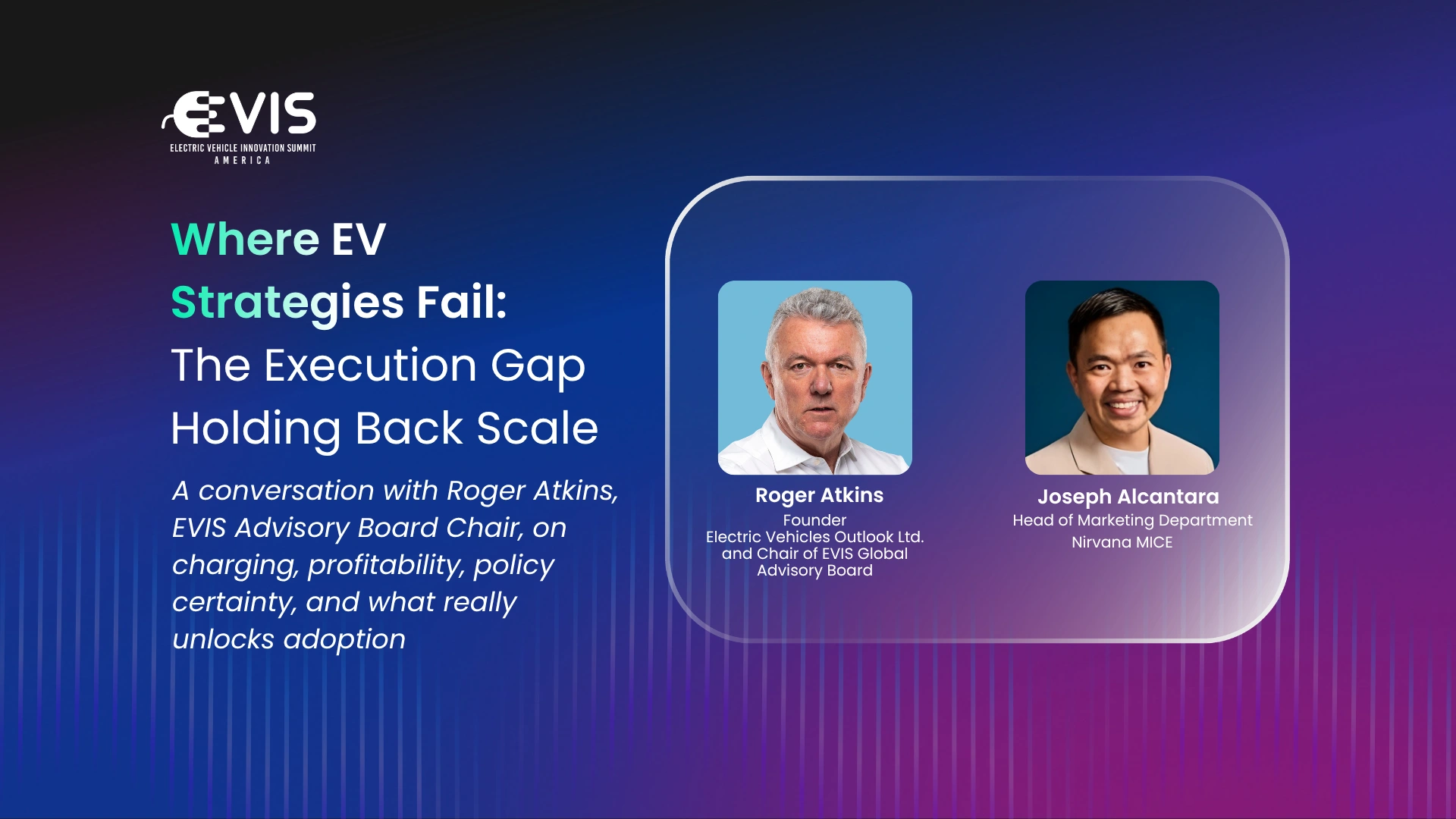
In this EVIS America podcast episode, Joseph Alcantara sits down with Roger Atkins, Founder of Electric Vehicles Outlook and EVIS Advisory Board Chair, to unpack a blunt question: why do EV strategies fail, and what needs to change for the next phase to scale?
1) The EV transition is underway, but it depends where you are
Roger’s first point is deceptively simple: the transition is “well on the way,” but the experience varies widely by geography.*
Even the baseline starting point differs. Roger highlights car ownership per 1,000 people as a useful lens, noting the U.S. sits around the high end of the spectrum.* The U.S. average for light-duty vehicle registrations is about 847 per 1,000 people, based on U.S. DOE analysis.*
That context matters because an EV rollout in a market with dense transit, lower car ownership, and more two-wheel mobility looks fundamentally different from a market built around multi-car households, long commutes, and suburban home charging.
2) The most common failure: treating charging as a government-only problem
If there is one strategic failure Roger returns to repeatedly, it is the expectation gap.
Some OEMs and stakeholders assume charging is primarily a government responsibility. In practice, large-scale public charging buildout has often depended on private investment, automaker initiatives, and charging operators, with uneven coordination.*
That misalignment creates the classic chicken-and-egg trap:
• You cannot justify massive charging investment without EV volume.
• Consumers hesitate to buy EVs without confidence they can charge easily.*
For many markets, early adoption was driven by people who can charge at home, because the experience is genuinely better than fueling a gas vehicle: plug in, sleep, wake up with a “full tank.”*
3) Profitability is not a footnote. It is the strategy
Roger offers a rarely stated but widely felt reality: incumbents do not fully understand the EV business model yet.*
The internal combustion era built decades of recurring revenue around parts, service, and maintenance. EVs shift that profit pool. Roger points to three evolving pillars:
• Energy (electrons instead of hydrocarbons)
• Software (features, updates, services)
• Data (emerging value, governance-dependent)*
His point is not theoretical. Customers and fleets care about long-term support. Investors care about predictable returns. Without a credible profitability story, strategies stall at pilot scale.
4) Policy certainty is a growth lever, not a political talking point
Roger’s recommendation to leaders is about runway.
Investors, entrepreneurs, and infrastructure builders need stability. He frames the minimum as 3 years, better as 5, and ideally 7, so stakeholders can plan, build, and recover investment without sudden rule changes.*
This is one reason why the EV transition often accelerates in markets with consistent, multi-year policy scaffolding and clearer industrial roadmaps.*
5) Charging is heading toward a blended future: cable, wireless, and swap
Charging is where strategy meets human behavior. Even when EV owners love home charging, public charging must become dependable enough to feel routine.
Roger is clear: there is no single winner. He expects a mix of cable charging, wireless charging, and battery swapping, with the “best” option being the one that is economically viable and fit-for-purpose.*
Two moments from the conversation stand out:
• He reflects on the enormous capital poured into autonomy and asks what might have happened if even a portion had gone into charging infrastructure.*
• He argues battery swapping is not just about speed. It can be about grid practicality and scaling, especially when many vehicles need energy in the same window.*
This matters for fleets and autonomy. If the promise of autonomy is lower friction and lower operating cost, charging cannot become a manual bottleneck.
6) The adoption challenge is also a fairness challenge
Roger makes a point that deserves more airtime: the EV transition has not yet been socially democratic.*
So far, many of the easiest wins have gone to buyers who can afford new vehicles and can charge at home. That is not a mass-market formula.
For EVs to be broadly accepted, they must become better for everyone, including people without home charging. That raises hard questions about affordability, public charging reliability, multi-unit dwelling solutions, and equitable infrastructure planning.
7) The near-term accelerator: commercial fleets and the economics-ecology match
Roger is bullish on electrifying commercial fleets: buses, vans, and trucks.* The logic is straightforward. High utilization makes total cost of ownership improvements more visible, and fuel savings become a direct operating advantage.
The IEA notes the value proposition for electric trucks is improving, and that higher utilization and lower energy costs can make battery-electric heavy-duty trucks more attractive, even when purchase prices remain higher in many markets.*
Roger frames the turning point as the moment ecological benefits and economic benefits align. When that happens, adoption stops being a moral argument and becomes an operational decision.*
Why EVIS America
EVIS America exists to narrow the execution gap.
If EV strategies fail when stakeholders work in silos, the solution is a platform designed for alignment: innovators, OEMs, infrastructure leaders, policymakers, and investors in the same room, solving the same set of constraints.
Roger’s closing message is simple and optimistic: “the future doesn’t just happen, it gets imagined and delivered by people,” and it is built by people working together.*
If you are shaping EV adoption, charging buildout, fleet electrification, standards, or next-generation mobility, EVIS America is where the practical conversations happen.
Explore sponsorship, exhibiting, speaking, partnership opportunities, or attendance via the EVIS America website.